 Shindo
 Triathlon · endurance · iPhone
Your first triathlon shouldn't start with
a thousand-dollar watch.
Swim, bike and run on the watch you already own. Shindo reads whatever it writes to Apple Health and builds a week around what your body actually absorbed — then rebuilds it when you miss a session.



The difference
The engine can overrule the model.
Every number you see in Shindo comes from a deterministic algorithm running on your iPhone — the same input always produces the same answer. The model receives finished numbers and writes about them, and where its wording disagrees with a computed value, the computed value wins.
What the engines decide
Your readiness score and every driver behind it. Training stress for each session, your fitness, fatigue and form curves, the phase you are in, today's target load, and your calorie and macro targets. All of it, on device, reproducibly.
What the model does
Turns those finished numbers into a morning briefing you can read in twenty seconds: what changed, why it matters, and what it means for the session in front of you. Tone, not arithmetic.
Where it gets checked
The weekly plan is the one place the model does more than write: it may propose a week, and a validator tests that proposal against limits computed from your own data — publishing the engine's own week if it does not pass. On the free tier the plan is always the engine's.
The app
Five screens, one continuous story
From this morning's decision, out to your race, and back down to the last interval of the session you just finished.
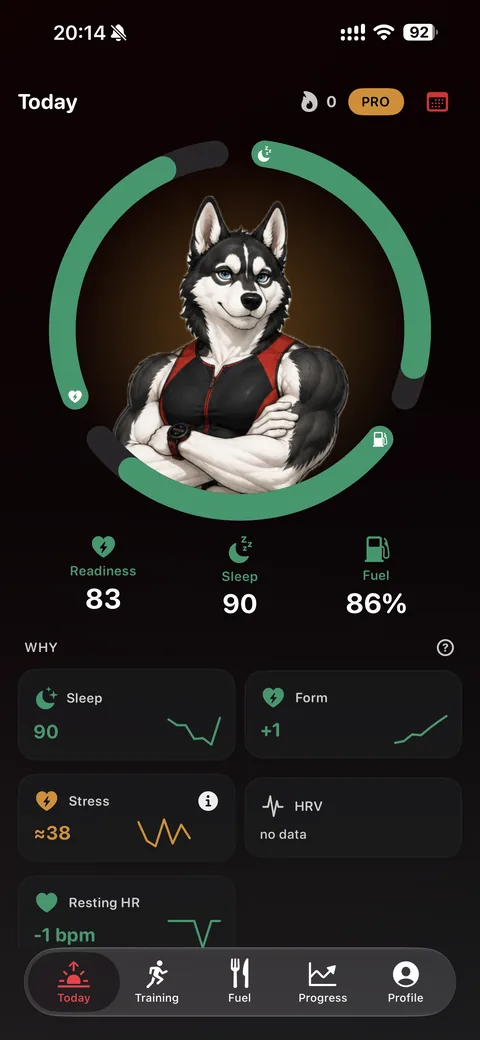
Today
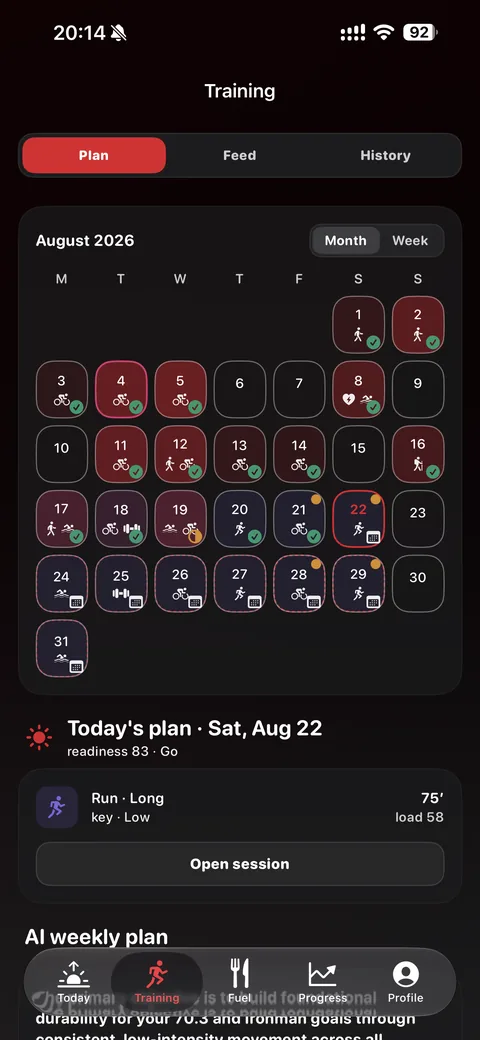
Training
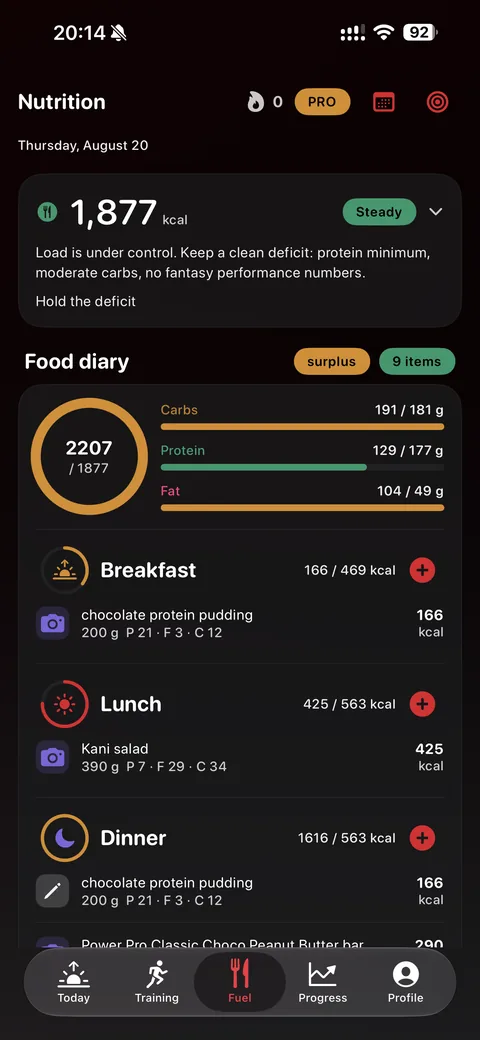
Fuel
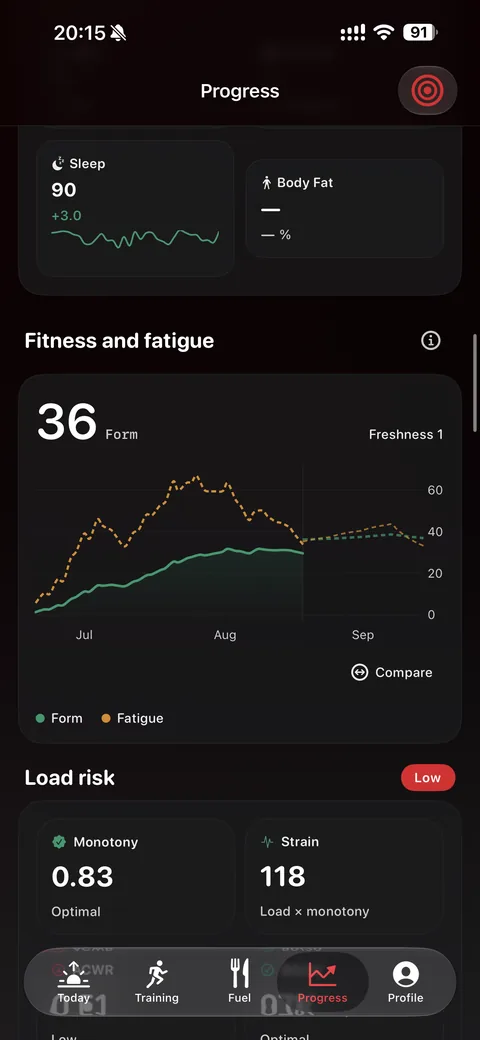
Progress
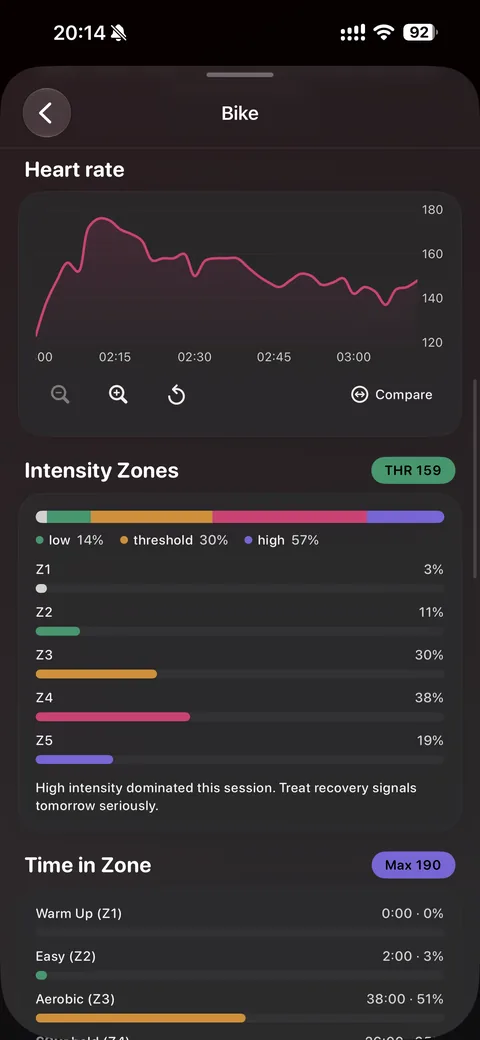
Workout detail
Screenshots from the iPhone app, unretouched.
What it does
Seven things, done properly
No streaks to protect, no arbitrary rings to close. Just the handful of measurements that actually change what a session should look like — and what they add up to.
Readiness, and why
One score, and the four drivers that produced it — sleep, heart-rate variability, resting heart rate and current form. Tap any driver to see its own baseline, your deviation from it, and how much it moved today's number.
Fitness, fatigue and form
Each session is scored as training stress, then rolled into the classic CTL / ATL / TSB curves. You see the fitness you have built, the fatigue you are carrying, and whether today lands in a productive window or a hole.
A week that makes sense
Base, build, peak and taper phases, a weekly ramp that is capped rather than heroic, and roughly four easy sessions for every hard one. Each session comes with its own steps, not just a duration.
Swaps and skips, understood
Rode instead of ran? Went short because of work? Shindo matches what you actually did to what was planned, counts the load you really absorbed, and re-flows the rest of the block. No guilt-red, no broken streak.
Fuel that follows the load
Calorie and macro targets that move with the session in front of you, an energy balance you can actually read, and an honest warning when you are eating far below what your training costs.
Patterns in your own data
Which of your habits actually move your numbers — sleep duration against next-day HRV, late meals against resting heart rate, load against form. Computed from your history, not from a study about somebody else.
Your watch, your data
Sleep, HRV, resting heart rate and workouts all arrive through Apple Health — whatever device wrote them there. Your watch, a chest strap, a smart scale, an app you already use: if it writes into Health, Shindo reads it. Duplicates of the same session are merged, not counted twice.
Free & Pro
The measurements are free. The interpretation is Pro.
Readiness, load, the plan, your workout detail and the widgets are free for your most recent 60 days — and computed identically whether you pay or not. Pro lifts that window, adds the parts that project forward, and everything the language model writes for you.
Free
- Readiness score and every driver behind it
- Training stress, fitness, fatigue and form charts
- Weekly plan with phases, the 80/20 split and a ramp cap
- Plan-to-actual matching, with swaps and partials counted
- Workout detail: laps, zones, decoupling, route
- Manual food and macro logging against daily targets
- All eight widgets and all three Live Activity modes, in full
- Push nudges, worded by the engine rather than the AI
- Your most recent 60 days of history
- Apple Health sync — whatever device wrote the data there
Pro
- The morning report — your day, explained in a paragraph
- The AI rebuild of your week, including “make it an easy week”
- The AI read-out of a journal entry you wrote
- Food from a photo or a description, and AI meal plans
- AI wording for the same nudges you already get for free
- Progress insights, correlations and the history of past reports
- Readiness and form forecast
- Race predictor, VO₂max trend and training status
- Your physiology model, energy availability and carb adherence
- Unlimited history — the 60-day window is lifted
Seven days free for new subscribers
New subscribers start with a seven-day free trial. It is an introductory offer, and eligibility is Apple's decision, per Apple ID and per subscription group — if you have already used a trial in the Shindo Pro group, you will not receive another one. With or without a trial, Pro is a subscription — the current price is shown in the App Store and depends on your region. You can cancel any time in your Apple account settings; the free features never expire. Section 6.3 of the Terms states it the same way.
One athlete, one device
Shindo is built for a single athlete on a single iPhone. There is no coach dashboard, no leaderboard, and no feed. Your health data is used to compute your numbers — nothing about it is required to be shared with anyone.
Questions
The four we get asked first
Thirty-nine more are answered in full on the FAQ page; troubleshooting lives in the support centre.
Do I need a Garmin?
No — and no other particular watch either. Shindo reads whatever your devices already write into Apple Health, so a Garmin, an Apple Watch, a Polar or a Whoop all arrive the same way. There is nothing to link and no second account to create.
Where do my numbers get computed?
On your iPhone. Readiness, load, phases and nutrition targets are all local and deterministic. Only the short text summaries are generated remotely, from an already-computed set of numbers.
What happens when I miss a week?
The plan re-flows around it. Missed sessions are recorded honestly, your fitness and fatigue decay as they really would, and the remaining weeks are rebuilt from where you actually are — not from where the old plan said you should be.
Which sports are supported?
Running, cycling, swimming and strength work, plus the triathlon combination of the first three. Load is scored per sport, so a hard swim and a hard ride land on the same fatigue curve.